
 EN
EN
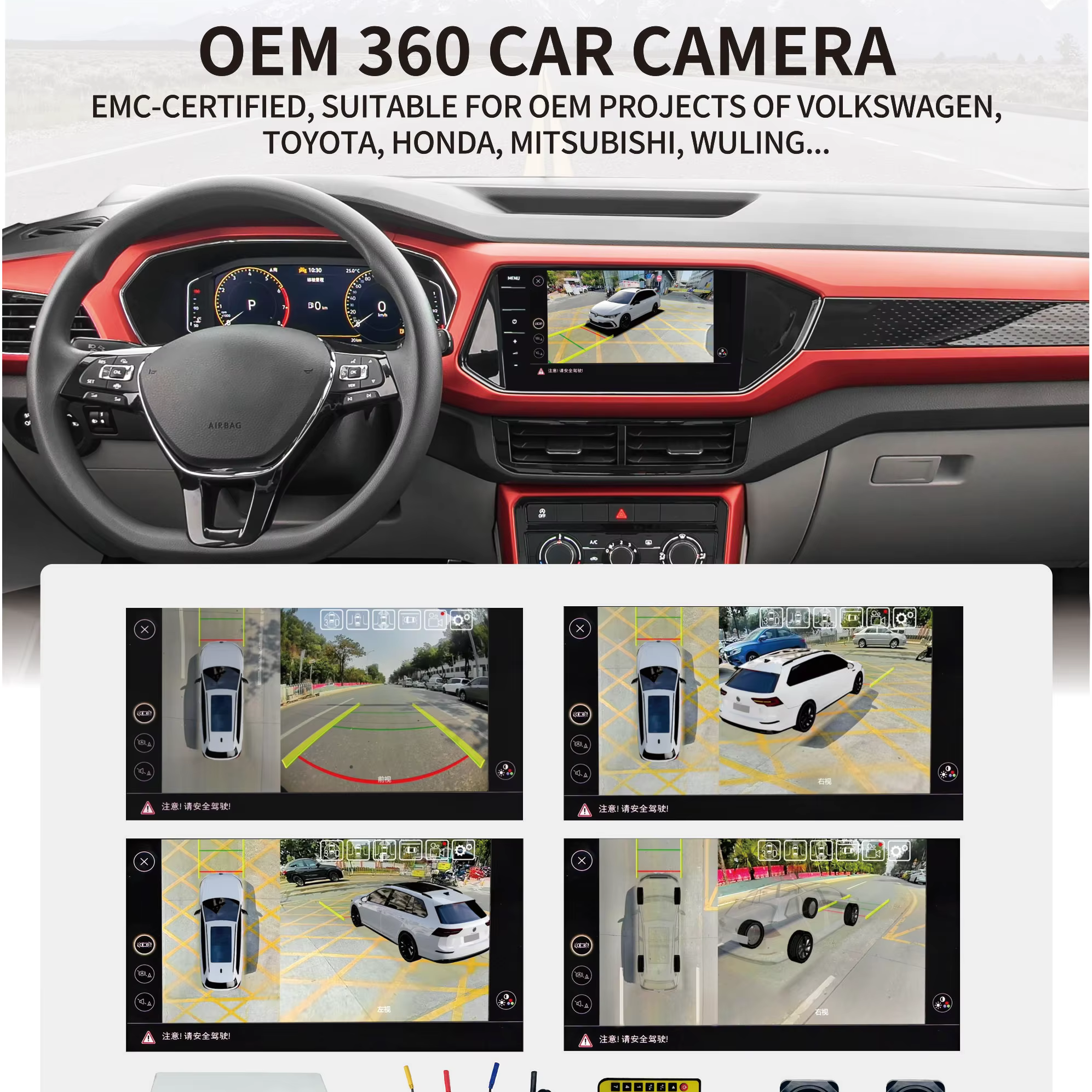
Strategic Mounting Placement for Complete Coverage
Optimal Height and Tilt: Balancing Field of View and Ground Detail
Mounting height and tilt directly determine whether a 360 bird's eye view camera delivers actionable detail or merely broad context. An 8–10 foot mounting height strikes the optimal balance: high enough to cover expansive zones like parking lots and loading docks, yet low enough to resolve license plates and facial features under typical lighting. A downward tilt of 15–30 degrees maximizes ground coverage while preserving horizon visibility—critical for detecting approaching pedestrians or vehicles. Avoid excessive angles, which introduce parallax distortion and compromise spatial accuracy across the stitched view.
Minimizing Blind Spots and Geometric Distortion Through Calibration
Even with precise placement, fisheye lenses inherently warp straight lines and create coverage gaps near structural obstructions. Calibration corrects this by mapping distorted pixels to their true physical positions in the bird’s eye plane—typically using a checkerboard pattern to compute intrinsic (lens/sensor) and extrinsic (mount position/orientation) parameters. To eliminate blind spots, rotate cameras to interlock coverage around columns or equipment, and design overlapping fields where each camera extends 15% beyond its neighbor. This redundancy ensures continuous visibility during single-camera outages or temporary occlusions—without requiring additional hardware.
Environmental Adaptation: Lighting, Lenses, and Weather Resilience
Managing High-Contrast Scenes with Dual-Exposure Fusion
Outdoor surveillance demands resilience in extreme lighting—such as sunlit pavement adjacent to deep shadows beneath vehicles. Dual-exposure fusion addresses this by capturing two synchronized frames at different exposure levels and merging them into a single high-dynamic-range (HDR) image. One frame preserves highlight detail; the other recovers shadow texture. When tuned to the specific lens-sensor combination, this technique avoids common artifacts like halos or motion ghosting—delivering consistent clarity across rapidly changing conditions.
Selecting and Calibrating Fisheye Lenses for Accurate 360 Bird's Eye View Camera Output
Fisheye lenses enable full surround coverage but require careful selection and calibration to support reliable bird’s eye output. Prioritize lenses rated IP67 or higher for dust- and water-resistance, along with low chromatic aberration and edge-to-edge sharpness—both of which reduce stitching errors and post-processing load. Calibration remains non-negotiable: it transforms raw, distorted feeds into geometrically accurate overhead maps. Once calibrated, the system maintains fidelity across temperature shifts and vibration—key for mobile or industrial deployments.
Stitching Performance and Real-Time Processing Optimization
A 360 bird's eye view camera system relies on seamless image stitching to create a unified, actionable overhead perspective. Latency, misalignment, and visual seams degrade situational awareness—especially when tracking moving objects. Optimizing stitching isn’t optional; it’s foundational to operational safety and decision speed.
Reducing Latency-Induced Misalignment in Multi-Camera 360 Bird's Eye View Camera Systems
Temporal misalignment between camera feeds causes “ghosting” or double imaging of moving objects—a critical flaw in vehicle-surround applications. Synchronizing timestamps via hardware triggers or precision network time protocol (PTP, not generic NTP) eliminates timing drift. Pairing synchronization with short-duration frame buffering and motion-compensated interpolation further aligns dynamic content across views. Industry testing confirms that end-to-end latency below 50 ms effectively eliminates perceptible misalignment in real-world driving and docking scenarios.
GPU-Accelerated Homography and Edge-Blending Techniques for Seamless Stitching
Homography transformation projects each camera’s curved fisheye view onto a shared top-down plane, while intelligent edge blending masks brightness and color discontinuities at seam boundaries. Offloading both operations to modern GPUs enables real-time processing of four 4K streams at 30 fps—without CPU bottlenecks. Adaptive blending algorithms adjust weights dynamically based on scene content, suppressing visible seams and preventing double images. The result is a cohesive, fluid visualization trusted in safety-critical environments—from autonomous shuttles to warehouse logistics systems.
Securing 360 Bird's Eye View Camera Data Across the Network
Network security is not an afterthought—it’s a prerequisite for deploying 360 bird's eye view camera systems responsibly. Unsecured video feeds expose drivers to privacy violations and fleet operators to regulatory liability under frameworks like GDPR and CCPA. Enforce end-to-end encryption: TLS 1.3 for live streaming and AES-256 for stored footage. Isolate camera traffic on a dedicated VLAN to contain potential breaches. Require multi-factor authentication (MFA) for all management interfaces, and only install firmware updates that are cryptographically signed and verified. Extend these controls to integrated control-center servers handling telemetry and video routing. Complement technical safeguards with regular penetration testing and immutable audit logs of all access events—turning security from a compliance checkbox into a continuous assurance practice.
Frequently Asked Questions (FAQ)
What is the ideal mounting height for a 360 bird's eye view camera?
An 8–10 foot mounting height is considered optimal as it balances broad coverage and detailed resolution, enabling the capture of license plates and facial features under typical lighting conditions.
How does calibration help minimize blind spots?
Calibration maps distorted pixels to their accurate physical positions using methods like checkerboard patterns. It eliminates blind spots by allowing overlapping coverage between cameras and removes distortion near structural obstructions.
What is dual-exposure fusion in 360 surveillance cameras?
Dual-exposure fusion captures two frames at varying exposure levels and combines them into one high-dynamic-range (HDR) image to effectively manage extreme lighting contrasts.
How can stitching optimization improve camera output?
Optimizations like GPU-accelerated homography and adaptive edge blending ensure seamless stitching, reducing latency, misalignments, and visual seams in multi-camera systems.
What security measures should be implemented for 360 camera networks?
Implement end-to-end encryption, VLAN isolation, multi-factor authentication, secure firmware updates, and cryptographically signed access logs to safeguard camera data across the network.