
 EN
EN
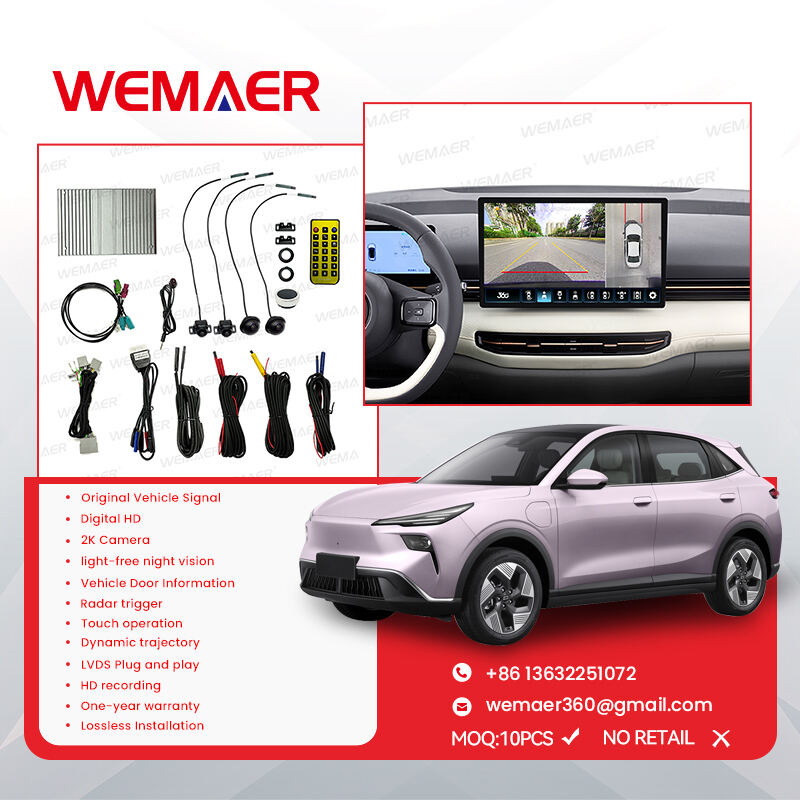
Why Fleet Operators & Automotive Businesses Choose 360° AVM Systems Over Traditional Safety Solutions
Eliminating Vehicle Blind Spots and Collision Risks with 360° Surround View Capture
Most traditional vehicle safety setups—relying solely on side mirrors and single backup cameras—leave dangerous, unaddressed blind spots around the vehicle. These gaps are responsible for 70% of low-speed collisions and 22% of fatal lane-change accidents, costing commercial fleets millions annually in repairs, downtime, and liability claims.
Automotive 360° Around View Monitor (AVM) systems solve this problem with complete, real-time perimeter visibility. Four ultra-wide-angle fisheye cameras mounted on the front, rear, left, and right of the vehicle capture every detail within 5 meters of the vehicle body simultaneously. Advanced real-time stitching and dewarping algorithms merge these feeds into a seamless, top-down bird’s-eye view displayed on the vehicle’s infotainment screen.
A single properly calibrated AVM system eliminates all critical vehicle blind spots: front and rear bumper zones, wheel arches (where curb scrapes and low-obstacle collisions occur), A-pillar shadows, and the large side "no-zones" that hide pedestrians, cyclists, and smaller vehicles. Fleets that have deployed AVM systems report a 71% reduction in parking-related scrapes and a 40% drop in overall low-speed collisions, according to IIHS 2025 data. For drivers, this means complete situational awareness without the need to mentally piece together information from multiple mirrors and cameras.
Reducing Total Cost of Ownership by 35–50% Through Lower Collisions and Simplified Maintenance
For businesses operating vehicle fleets, the biggest cost savings from AVM systems come not from hardware itself, but from reduced operational expenses. To illustrate: a 100-vehicle commercial fleet without AVM systems spends an average of $1.2 million annually on collision repairs, insurance premiums, and vehicle downtime.
By contrast, deploying a 360° AVM system delivers measurable hard and soft savings:
- Hard savings: $740,000 annual reduction in repair costs, plus 10–25% lower insurance premiums (averaging $0.07 per mile driven)
- Soft savings: 20% less vehicle downtime (translating to higher asset utilization) and significantly reduced liability exposure
Installation and maintenance costs are also drastically lower than retrofitting multiple discrete cameras. Modern AVM systems use a single central processing unit and simplified wiring harnesses, cutting installation time by 60% compared to traditional multi-camera setups. With no moving parts and self-calibrating capabilities in premium models, long-term maintenance costs are reduced by 70% over a five-year period.
Industry reports show that fleets achieve a payback period of just 7–9 months for aftermarket AVM systems, with total cost of ownership savings of 35–50% over five years. These savings turn vehicle safety from a fixed operational expense into an investment that delivers measurable bottom-line returns.
Key Features That Define an Automotive-Grade 360° AVM System
AI-Powered Object Detection and Proactive Collision Warning
Automotive-grade 360° AVM systems deliver far more than just passive video display. These solutions feature built-in edge-based AI processing that detects, classifies, and tracks objects in real time across all four camera feeds. The AI can distinguish between pedestrians, cyclists, other vehicles, and low obstacles (curbs, parking blocks), triggering audible and visual alerts when objects enter the vehicle’s immediate danger zone.
Advanced temporal context filtering reduces false positive alerts by 62% compared to basic motion sensors, eliminating annoying warnings triggered by shadows, road debris, or tree branches. The system automatically adjusts sensitivity levels based on vehicle speed and driving scenario—higher sensitivity during parking and low-speed maneuvering, lower sensitivity on highways—ensuring optimal performance without distracting drivers.
All-Weather Performance: HDR, Low-Light Imaging, and Automotive-Grade Durability
Reliability in extreme driving conditions is not a bonus feature for automotive systems—it is a mandatory requirement. Top-tier 360° AVM systems integrate three core technologies to ensure consistent 24/7 performance:
- HDR Imaging: Dynamically balances highlights and shadows to preserve critical detail in high-contrast scenes, such as sunlit parking lots or tunnel entrances, ensuring license plates and pedestrian features remain clearly legible.
- Low-Light Sensors: Large-pixel Sony sensors capture usable color footage at just 0.005 lux (equivalent to moonlight-level illumination), delivering superior clarity compared to standard IR night vision.
- Automotive-Grade Durability: IP67-rated sealed housings withstand dust, heavy rain, and immersion in up to 1 meter of water for 30 minutes. Components are rated to operate reliably between -40°C and +85°C, with reinforced mounting brackets to withstand constant road vibration and shock.
Field data from commercial fleets shows these features deliver 98% operational uptime, eliminating weather-related failures that routinely compromise cheaper aftermarket systems.
Proven Commercial Applications for Automotive 360° AVM Systems
Passenger Vehicle OEMs: Standard Safety Feature for Modern Cars and SUVs
For automotive manufacturers, 360° AVM systems have become a must-have standard feature for mid-range and premium vehicles. Consumers increasingly prioritize parking assistance and active safety features when purchasing new cars, with 68% of buyers listing 360° surround view as a top-three consideration in 2025.
AVM systems enhance the user experience by simplifying parking in tight urban spaces, reducing curb scrapes and bumper damage. Premium systems also offer additional features such as transparent chassis mode (showing the road surface directly under the vehicle) and automated parking assistance, further differentiating vehicle models in a competitive market.
Commercial Fleets and Logistics: Reducing Collisions and Downtime
For delivery vans, box trucks, and semi-trailers, blind spots are a leading cause of fatal accidents and operational disruption. A customized 360° AVM system provides drivers with a complete view of the vehicle’s entire perimeter, including the areas directly in front of the cab, alongside the trailer, and behind the rear wheels.
Fleet operators that have deployed AVM systems report:
- 40% reduction in low-speed parking and docking collisions;
- 22% reduction in lane-change accidents;
- 31% faster incident resolution time thanks to clear, comprehensive video evidence.
The systems integrate seamlessly with existing fleet telematics platforms, automatically recording and uploading footage of collision events for insurance and training purposes.
Specialty Vehicles: Enhancing Safety for High-Risk Operations
360° AVM systems are also critical for specialty vehicles operating in high-risk environments, including school buses, construction equipment, forklifts, and emergency vehicles:
- School buses: Eliminate blind spots around bus doors and wheels, ensuring the safety of children boarding and alighting
- Construction equipment: Allow operators to see around large vehicle bodies and attachments, preventing collisions with workers and other equipment on job sites
- Emergency vehicles: Provide clear visibility during tight maneuvers in crowded urban areas, allowing first responders to reach their destinations quickly and safely
How to Select the Right 360° AVM System for Your Automotive Business
Resolution, AI Capabilities, and Compatibility: Balancing Performance and Cost
Selecting the optimal 360° AVM system for your business depends on aligning three core, interdependent elements: resolution, on-board intelligence, and vehicle compatibility.
Resolution must be matched to your specific use case, not just marketing specifications. Prioritize 4K resolution for commercial fleets requiring clear accident footage for insurance and liability purposes. For general passenger vehicle parking assistance, 2K resolution delivers an optimal balance of clarity and processing efficiency.
Edge-based AI processing is essential for reliable real-time performance. When the system analyzes footage locally on the vehicle’s central processing unit rather than sending data to the cloud, it delivers sub-500ms response times and operates reliably even without cellular connectivity. Look for systems that support over-the-air (OTA) software updates, allowing you to add new features and improve performance over time.
Vehicle compatibility is critical for seamless integration. Universal aftermarket systems work with 99% of vehicle models, while custom-fit systems integrate directly with the vehicle’s original infotainment screen and electrical system, providing the same performance as factory-installed units. For OEM projects, choose a provider that can develop fully customized solutions tailored to your specific vehicle platform.
Ready to Deploy a High-Performance 360° AVM System Tailored to Your Automotive Business?
A reliable, automotive-grade 360° surround view system is the irreplaceable foundation of modern vehicle active safety—no other feature can eliminate the blind spots responsible for the majority of low-speed collisions and deliver such significant cost savings for fleet operators and automotive manufacturers. By choosing an AVM system aligned with your vehicle type, operational needs, and long-term business goals, you will unlock measurable collision reduction, lower insurance and repair costs, and a safer, more confident driving experience for all users.
For industrial-grade, OEM-quality 360° AVM systems, automotive rearview cameras, and dash cam solutions tailored to passenger vehicles, commercial fleets, and specialty vehicles, partner with WEMAER—a leading automotive vision provider rooted in 15 years of deep industry expertise. As a national high-tech enterprise boasting China’s top production scale for car rearview cameras, dash cams, and 360° AVM systems, WEMAER houses a 30+ professional R&D team, holds over 100 technology patents, and ensures full compliance with global automotive certifications including IATF 16949, CE, FCC, RoHS, and CQC. Our AVM systems feature automotive-grade durability, AI-powered object detection, and seamless integration with vehicle infotainment and ADAS systems. We support end-to-end OEM/ODM customization services, from hardware design and lens optimization to deep UI and system-level integration, serving 20+ well-known automotive brands and exporting to more than 60 countries worldwide. Whether you need a scalable aftermarket solution for your commercial fleet, or a factory-grade custom AVM system for new vehicle models, we can build a high-performance, cost-effective solution aligned with your safety and performance goals. Contact us today for a no-obligation consultation and customized solution planning.
Table of Contents
- Why Fleet Operators & Automotive Businesses Choose 360° AVM Systems Over Traditional Safety Solutions
- Key Features That Define an Automotive-Grade 360° AVM System
- Proven Commercial Applications for Automotive 360° AVM Systems
- How to Select the Right 360° AVM System for Your Automotive Business
- Ready to Deploy a High-Performance 360° AVM System Tailored to Your Automotive Business?