
 EN
EN
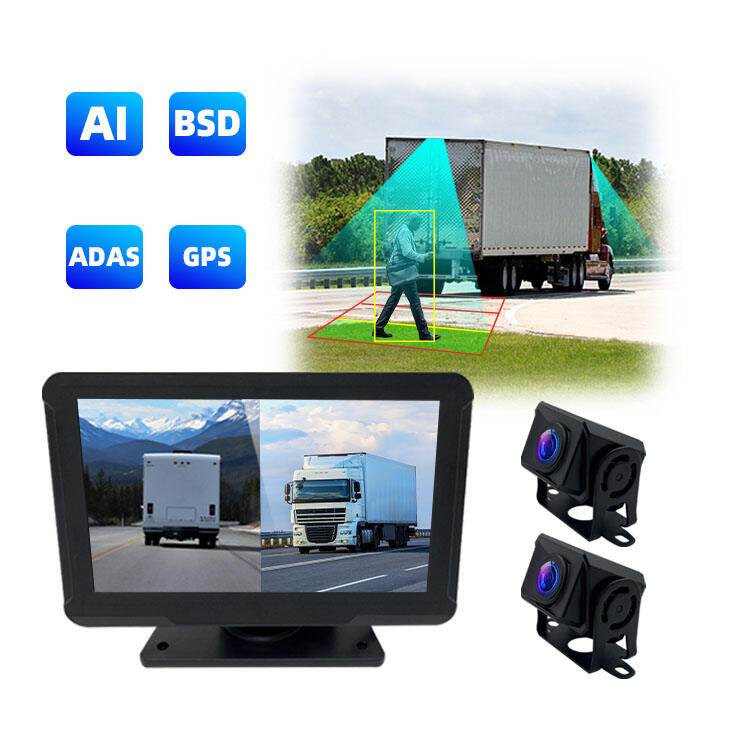
Why Rear View Cameras for Trucks Are Essential: Regulatory Drivers and Safety Imperatives
Rising backing accidents and FMCSA compliance mandates
Backing accidents cause over 267 annual U.S. fatalities according to NHTSA data—a risk exponentially higher for commercial trucks with massive blind zones. FMCSA §399.21 now mandates rear visibility technology for vehicles over 10,000 lbs, with non-compliance fines reaching $16,000 per violation. This regulation directly addresses the 34% of warehouse incidents involving reversing trucks, where traditional mirrors fail to detect pedestrians or obstacles near rear bumpers. Proactive adoption not only avoids penalties but demonstrates fleet commitment to Duty of Care principles recognized by OSHA.
How rear view cameras for trucks reduce blind spots versus mirrors alone
Mirrors alone leave critical coverage gaps: while side mirrors cover approximately 190 degrees, rear view cameras extend the field of view to 180–270 degrees directly behind the vehicle. This eliminates the 50-foot blind spot typical in Class 8 trucks—where 35% of backing collisions occur. Camera systems with dynamic guidelines show real-time trajectory prediction during maneuvers, a capability impossible with static mirrors. IR-enhanced models maintain visibility in darkness where mirror effectiveness drops by 80%, and pedestrian detection algorithms provide audible alerts for unseen hazards.
Stats: NHTSA (2023), FMCSA §399.21, OSHA Guidance 2024
Key Types and Features of Rear View Cameras for Trucks
Wired vs. wireless systems: reliability, latency, and fleet scalability
Wired systems deliver consistent performance with near-zero latency—critical for high-speed maneuvers—though installation complexity increases for multi-trailer fleets. Wireless alternatives offer flexibility for trailer swaps, with modern solutions achieving ranges exceeding 300 feet, but require robust signal encryption to prevent interference. Fleet scalability favors wireless for mixed-asset operations, while wired configurations suit dedicated routes with fixed trailer pairs.
Critical features: auto-panning, dynamic guidelines, low-light IR, and VRU detection
Modern rear view cameras incorporate four essential capabilities:
- Auto-panning technology, which adjusts viewing angles during turns to eliminate traditional blind zones
- Dynamic guidelines, curving with steering inputs to predict trailer paths during docking
- Infrared (IR) night vision, enabling object detection in 0-lux conditions and reducing nighttime incidents by 37% (NHTSA 2024)
- Vulnerable Road User (VRU) detection, highlighting pedestrians and cyclists within 10-meter rear zones
Leading systems combine these with 170-degree lenses to create comprehensive rear coverage—significantly outperforming mirror-only setups in obstacle identification during FMCSA compliance audits.
Measurable Safety Benefits and Real-World Performance of Rear View Cameras for Trucks
NHTSA and FMCSA data on crash reduction and driver confidence gains
Federal safety data confirms rear view cameras significantly reduce collision risks. NHTSA reports a 30% decrease in backing accidents among fleets using camera systems versus mirror-only setups. FMCSA studies further show a 27% drop in blind-spot incidents when cameras are deployed. Drivers experience measurable confidence gains: 78% report reduced stress during reversing maneuvers according to 2023 driver surveys. This technology transforms high-risk operations into controlled procedures by eliminating guesswork—and preventing costly errors before they escalate.
Case evidence: Class 8 fleet adoption rates and ROI in incident avoidance
Class 8 fleets now adopt rear view cameras at three times the rate of 2020, driven by compelling ROI evidence. Fleets report an average annual savings of $740,000 (Ponemon 2023) through avoided incidents—including property damage, injury claims, and downtime. Insurance premium reductions of 12–15% further amplify savings for adopters. One logistics operator documented 47% fewer low-speed collisions post-implementation, translating to $1.2 million in two-year cost avoidance. These systems pay for themselves within 18 months through incident prevention alone.
Practical Limitations and Mitigation Strategies for Rear View Cameras for Trucks
While rear view cameras dramatically enhance safety, they face operational constraints in demanding environments. Heavy rain, snow accumulation, or mud splatter can obstruct lenses; extreme temperatures may cause image distortion or system latency; and vibrations from uneven terrain challenge mounting integrity. To counter these limitations, implement daily visual inspections and scheduled lens cleaning protocols. Pair cameras with ultrasonic proximity sensors to create redundant detection layers—especially for bumper-level blind zones. In low-visibility scenarios like fog or dust storms, supplement camera views with trained spotters using standardized hand signals. Fleet-wide driver training should emphasize interpreting camera limitations—such as depth perception variances at night—while reinforcing mirror-scanning fundamentals. Combining these strategies ensures maximum reliability of vision systems where failure carries the highest consequences.
Ready to Enhance Fleet Safety and Ensure FMCSA Compliance with Industrial-Grade Truck Rear View Cameras?
Reliable rear view camera systems are the non-negotiable foundation of commercial fleet safety and regulatory compliance—no other technology delivers such significant reductions in backing accidents, liability exposure, and operational costs. By selecting a system engineered specifically for heavy-duty trucking environments, you will achieve measurable crash reduction, lower insurance premiums, and full compliance with global transportation safety regulations.
For OEM-quality truck rear view cameras, commercial vehicle monitoring systems, and integrated 360° AVM solutions tailored to your fleet or automotive manufacturing project, partner with WEMAER—a global leader in automotive vision technology with 15 years of specialized industry expertise. As a national high-tech enterprise boasting China’s largest production scale for car rearview cameras, dash cams, and 360° AVM systems, WEMAER houses a 30+ professional R&D team, holds over 100 technology patents, and ensures full compliance with global certifications including IATF 16949, CE, FCC, RoHS, and CQC. Our heavy-duty camera systems feature IP67 ingress protection, anti-vibration mounting, and extreme temperature resistance, purpose-built to withstand the harshest commercial operating conditions. We offer end-to-end OEM/ODM customization services, from hardware design and lens optimization to full integration with your fleet telematics platform, serving 20+ well-known automotive brands and exporting to more than 60 countries worldwide. Whether you need a scalable retrofit solution for your existing fleet or a custom-engineered camera system for new commercial vehicle models, we can deliver a high-performance, cost-effective solution aligned with your safety and business goals. Contact us today for a no-obligation consultation and customized solution planning.
FAQ
Why are rear view cameras mandatory for trucks?
Rear view cameras are mandated for trucks over 10,000 lbs to address high backing accident rates and comply with FMCSA §399.21, reducing blind zone-related incidents.
How do rear view cameras for trucks reduce blind spots?
Rear view cameras extend visibility to 180–270 degrees behind the truck, eliminating the 50-foot blind spots common with side mirrors alone.
What types of rear view camera systems are available for trucks?
Both wired and wireless systems are available, with benefits like low latency for wired systems and flexibility for wireless setups in trailer swaps.
What are critical features of modern rear view cameras?
Key features include auto-panning, dynamic guidelines, infrared night vision, and Vulnerable Road User detection, all enhancing rear vision and safety.
Table of Contents
- Why Rear View Cameras for Trucks Are Essential: Regulatory Drivers and Safety Imperatives
- Key Types and Features of Rear View Cameras for Trucks
- Measurable Safety Benefits and Real-World Performance of Rear View Cameras for Trucks
- Practical Limitations and Mitigation Strategies for Rear View Cameras for Trucks
- Ready to Enhance Fleet Safety and Ensure FMCSA Compliance with Industrial-Grade Truck Rear View Cameras?
- FAQ